About PBJ320
PBJ320 Nursing Home Intelligence
A free public resource by 320 Consulting
As seen in Columbia Public Health, McKnight’s, and Aging in America News
The timeline tells a story. PBJ320 helps you read it.
Staffing data is one of the clearest ways to understand how a nursing home is actually operating: how much care residents receive, who is providing it, and how those patterns change over time. But most public-facing data shows only the latest quarter, which can make a long-running problem — or improvement — look like a single point in time.
PBJ320 stitches together nearly a decade of CMS Payroll-Based Journal (PBJ) staffing data into interactive visualizations, connecting that history with facility characteristics, ownership, ratings, and other public data that can help put staffing patterns in context. It covers 16,000+ U.S. nursing homes, making it possible to look backward, compare facilities and places, and follow the organizations associated with them.
I built PBJ320 after spending years working with nursing home data in policy and advocacy. Too much of that work involved downloading separate CMS files, joining quarters together, checking definitions, and reconstructing history before you could even start asking the interesting question: What has actually been happening here?
PBJ320 is my attempt to make that part easier — and make more of the public record genuinely usable.
Audiences
Who it helps
Attorneys
Identify staffing patterns and trends that may support negligence cases, regulatory violations, or quality of care claims. Access historical data to demonstrate chronic understaffing, seasonal variations, or ownership-related staffing deficiencies.
Reporters
Plug numbers and data visualizations into a nursing home investigation or ownership-focused report without wrangling raw CSVs.
Advocates & families
See how a nursing home stacks up over time for residents and loved ones.
Providers
Use historical staffing data to identify gaps, benchmark performance, and support quality improvement efforts.
Explore
What you can explore
Nurse staffing hours per resident day (HPRD), contract staff %, census—every quarter since 2017.
FacilitiesStaffing, contract share, census, ratings, and historical facility indicators.
OwnersNursing home owners, ownership roles, portfolios, and related facilities.
Special Focus FacilitiesCheck out the Special Focus Facilities and SFF candidates, with their staffing data and SFF history.
Sources
Under the hood
- Payroll-Based Journal (PBJ) Staffing Data33 quarters of daily data, aggregated for clarity (what is PBJ?)
- CMS Provider Info5-star ratings, enforcement data, and other key indicators
- CMS SNF OwnershipOwner identities, ownership roles, and facility relationships
- CMS Affiliated EntityQuality and performance metrics for affiliated nursing home groups (see an example entity page)
- CMS Special Focus Facility listSFF and SFF candidate status for facilities (USA SFF page)
Case study
The Other 3,000 Days at Seagate
Where nursing home understaffing is the rule, not the exception
In September 2025, a Brooklyn nursing home made national headlines after the violent death of an 89-year-old Holocaust survivor. Federal records point to a deeper problem: Seagate Rehabilitation and Nursing Center has been marked by chronic understaffing—one of thousands of U.S. nursing homes with similar conditions. Since New York’s staffing standard took effect, Seagate has fallen below the 3.50 HPRD threshold on every reported PBJ day reviewed through Q1 2026, according to CMS Payroll-Based Journal (PBJ) data.
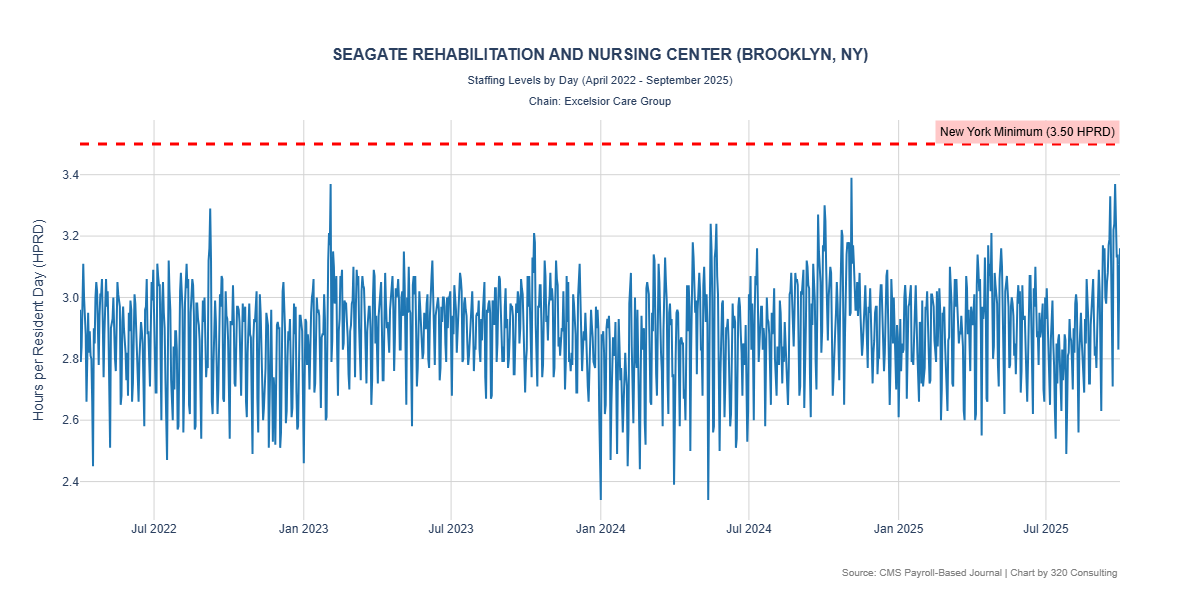
Seagate Rehabilitation and Nursing Center has been marked by chronic understaffing—one of thousands of U.S. nursing homes with similar conditions.
PBJ data enables this analysis by providing daily staffing records, historical context, regulatory compliance tracking, and pattern recognition—revealing systemic issues that affect resident care across thousands of facilities. Read the full analysis or explore Seagate's public staffing page.

Who built PBJ320
Eric Goldwein, MPH · Founder, 320 Consulting
I’m Eric Goldwein, MPH. I built PBJ320 after several years working with nursing home staffing, ownership, and other federal datasets at the Long Term Care Community Coalition, where I served as policy director.
Before working in long-term care, I was a journalist covering health, sports, and education. That background still shapes how I approach the data: follow the evidence, look for the pattern behind the headline, show your work, and try not to confuse what the numbers suggest with what they can actually prove.
PBJ320 grew out of that approach. It is not meant to replace CMS data or create another black-box rating. The goal is to organize the public record well enough that attorneys, reporters, advocates, families, providers — or anyone else who is curious — can ask better questions of it.
My nursing home data work has been featured in Columbia Public Health, McKnight’s, the Journal of the American Geriatrics Society, Positive Aging, and Aging in America News. I have presented to audiences including the National Association of Medicaid Fraud Control Units, Consumer Voice, the American Society on Aging, and long-term care ombudsman programs.
Digging deeper?
320 Consulting offers PBJ320 Premium: custom reports with daily, position-level analysis and data visualizations tied to ratings, enforcement, and other critical metrics to support your casework and advocacy. View a sample dashboard or request a demo.
Reporters: If you're working on a story, I'm happy to share data or walk you through it. Contact us for requests.
Methodology
How the numbers work
PBJ320 uses CMS Payroll-Based Journal (PBJ) data from 2017–2026, covering all nursing positions, including contract staff. CMS first published PBJ data in 2017. It also uses Provider Information, Affiliated Entity, CMS SNF ownership, MACPAC State Staffing Standards (2022), and FEC campaign finance data. See data sources and methodology.
Staffing categories
Total nurse staff includes:
- Registered Nurse (RN)
- RN Director of Nursing (DON)
- RN Admin
- Licensed Practical Nurse (LPN)
- LPN Admin
- Certified Nursing Assistant (CNA)
- Nurse Aide in Training
- Medication Aide/Technician
Metrics explained
- Total Nurse Hours Per Resident Day (HPRD)*
- Total nurse staff hours per resident per day.
- Direct Care (excl. Admin, DON)
- Hours per resident day for direct care staff only (RN, LPN, CNA, NAtrn, MedAide), excluding administrative and supervisory roles.
- Contract Staff Percentage
- Percentage of nurse staff hours provided by contract staff.
- Census
- Average number of residents in facility or state during the reporting period.
* HPRD Explained: This metric reflects the staffing ratio at a facility in terms of staff hours per resident. Example: A nursing home with 100 residents providing 350 staffing hours per day would have a 3.5 HPRD (350 ÷ 100). See what is HPRD?
A 2001 CMS report to Congress identified 4.1 HPRD as a level discussed in that staffing adequacy study, not a current federal minimum. Facilities with higher-acuity residents—such as those with complex medical needs or limited mobility—generally require more staffing. Staffing levels can also vary significantly by day and shift.
There is currently no federal numerical HPRD minimum in effect. Some states maintain their own staffing standards, with definitions and enforcement varying by state. See MACPAC State Staffing Standards and methodology.
Transparency note
PBJ320 pulls directly from CMS data and is carefully vetted for accuracy. Still, sometimes a bug sneaks into the jelly.
That could mean:
- A facility reported bad data to CMS (more common than you'd think).
- Or I made a coding error (it happens).
Either way, I want to be the first to know. If something looks wrong, submit a correction so I can check the source data and code.

Phoebe J's PBJ Guide
Plain-language explainer of nursing home Payroll-Based Journal (PBJ) staffing data—what it is, why it matters, and how to use it.
What is PBJ?